



No client has ever come to us with the pain point that employees don’t do the task(s) they are assigned to. It’s never about accountability for completing tasks.
What organisations truly want from their employees is accountability for outcomes. This is the foundation of a culture of accountability in teams and a critical part of understanding how to build a high-performing team.
Accountability for actions vs. accountability for outcomes
Accountability for actions (output) means being answerable for completing a task to standard. The report was filed, the meeting was held, the deliverable shipped. It’s activity-focused. Success is measured by “did I do my part?”.
Accountability for outcomes means being answerable for whether that action actually moved the needle. Did the report change a decision? Did the deliverable solve the problem it was meant to solve? Success is measured by “did my part actually work?”
A person or an entire team can score 100% on the first and still fail completely on the second. That gap is where most performance problems, missed deadlines, and stalled projects actually originate.
Why the Accountability Gap Exists in Teams
In 2005, I started my career as a flight attendant. It’s a job where every single day, you’re working with a brand-new group of people. Different crew, different mix of nationalities, different dynamic on every flight.
What was peculiar was that on some flights, I went out of my way to make it a great one. No complaints. Passengers walking off with a genuine smile. The crew was already planning where we’d grab dinner together after landing. And on other flights, I did exactly what I was responsible for. Kept my head down, got the job done, and counted the hours until I could go home.
Same person. Same job. Same aircraft. Wildly different flight.
So, what made the difference?
Behaviour researcher and psychologist Kurt Lewin proposed a simple, powerful formula:
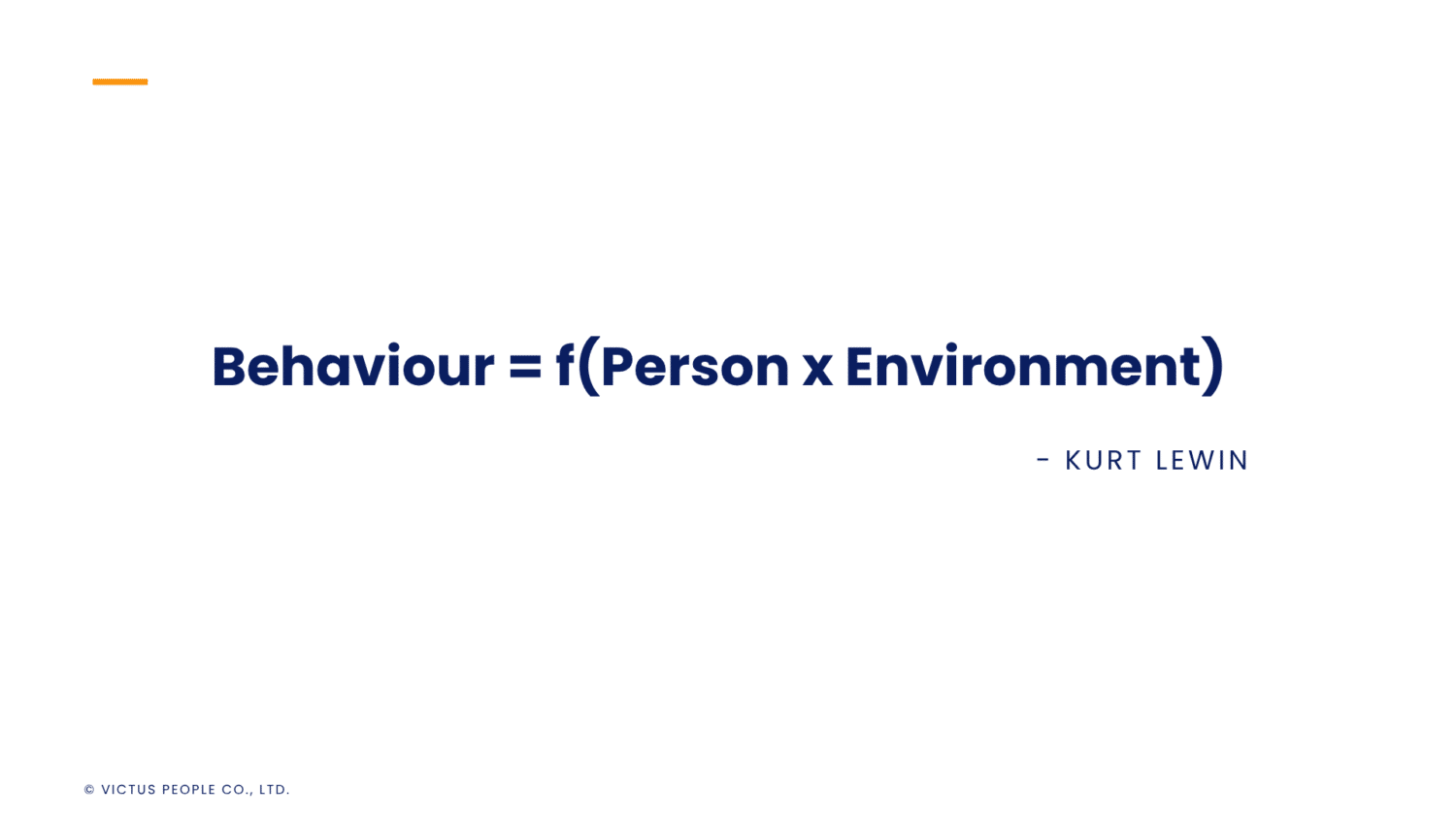
In plain terms, how someone behaves at work isn’t just about who they are, but it’s also shaped by the environment around them.
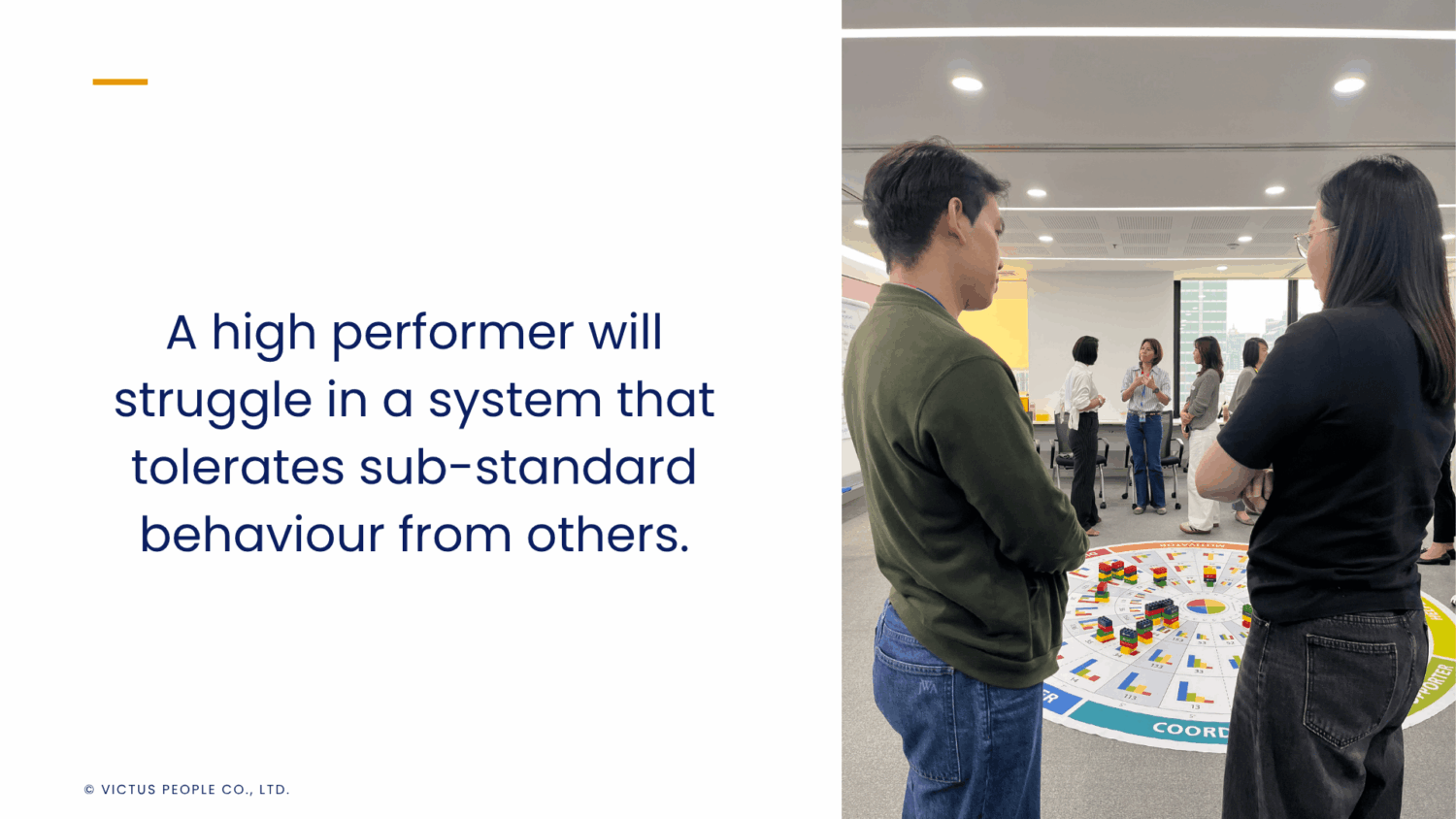
This means you can have a genuinely high-performing individual who struggles and eventually disengages or lowers their own standard inside a system that tolerates sub-standard behaviour from everyone else.
If you want to see accountability for outcome show up in a team, you need both halves of that equation working together.
People who are genuinely committed to the outcome, inside a culture and a process that actually promotes, recognises, and celebrates that kind of ownership.
Neither half compensates for the other. A committed individual placed inside a system with no clear mechanisms for tracking progress or surfacing issues will eventually default to the lowest standard tolerated around them. And a well-designed system without genuinely invested people just produces compliance, not ownership. This is the same principle behind aligning cross-functional teams — the human factor and the systems factor have to be built at the same time, not one after the other.
Three simplest markers to look for in your team:
-
Ownership — do they own mistakes, or deflect them?
-
Initiative — do they act, or wait to be told?
-
Investment — do they actually care how it turns out, or just that it’s done?
Three main blockers to build accountability-for-outcomes in your team
Blocker #1: The leader brings the weather
A while back, we were working with a global organisation’s Thailand branch. This is what their people managers told us:
“We’re scaling fast, but we’re struggling with internal alignment. Our people are hardworking, caring and genuinely good people. But right now, we have a ‘that’s not my problem’ problem. We want them to act like owners, not just do what they’re told.”
Patrick Lencioni’s Five Dysfunctions of a Team puts accountability at level four. Meaning, a team has to work through three layers before they even get there. And right at the bottom, holding everything else up, is trust.
That’s exactly what was missing in this team.
Trust between the leader and the team was thin. What we picked up in conversation was a self-awareness gap. This leader didn’t see their own blind spots, and didn’t fully register how their own style was quietly draining the team’s commitment. It’s hard to fix a blind spot you can’t see, which is usually where a tool like Insights Discovery earns its keep.
A high-performing team needs an emotionally intelligent leader who can read the room and pick the signals their team members are sending.
Blocker #2: The system doesn’t support accountability-for-outcomes behaviour
Recently, we were on a call with another client. A large multinational conglomerate. They wanted us to build a program for their high-potential talent.
We asked what they wanted the program to focus on. Their response: commitment to outcomes.
“The problem I keep running into,” they told us, “is that people sit on their work. They don’t proactively pick it up. They wait for the order to land in their inbox instead of going out and getting it from the customer. If we actually want to grow, if we want to become a genuinely high-performing organisation, that’s not there yet.”
When the pain point is presented as a general problem of an entire office, branch, or country, that’s not an individual problem anymore. That’s a system problem. A culture problem. Employee accountability cannot be separated from the environment in which people work.
Let me give you the opposite extreme.
Netflix built a culture where “accountability for outcomes” is so strong, only people whose attitude and skills genuinely fit it survive there.
Reed Hastings and Erin Meyer lay out how they did it in No Rules Rules.
3-step build (in a sequence)
First, build talent density: Hire only the best, pay them at the top of the market, and don’t tolerate mediocrity. Their logic is good work motivates more good work, and bad performance is contagious.
Then, increase candor: Say what you think, with positive intent. And it has to be modelled from the top, not just expected from everyone else.
Only then, remove the controls: Netflix famously stripped out things like vacation policies and expense approval chains. Replacing them with one expectation.
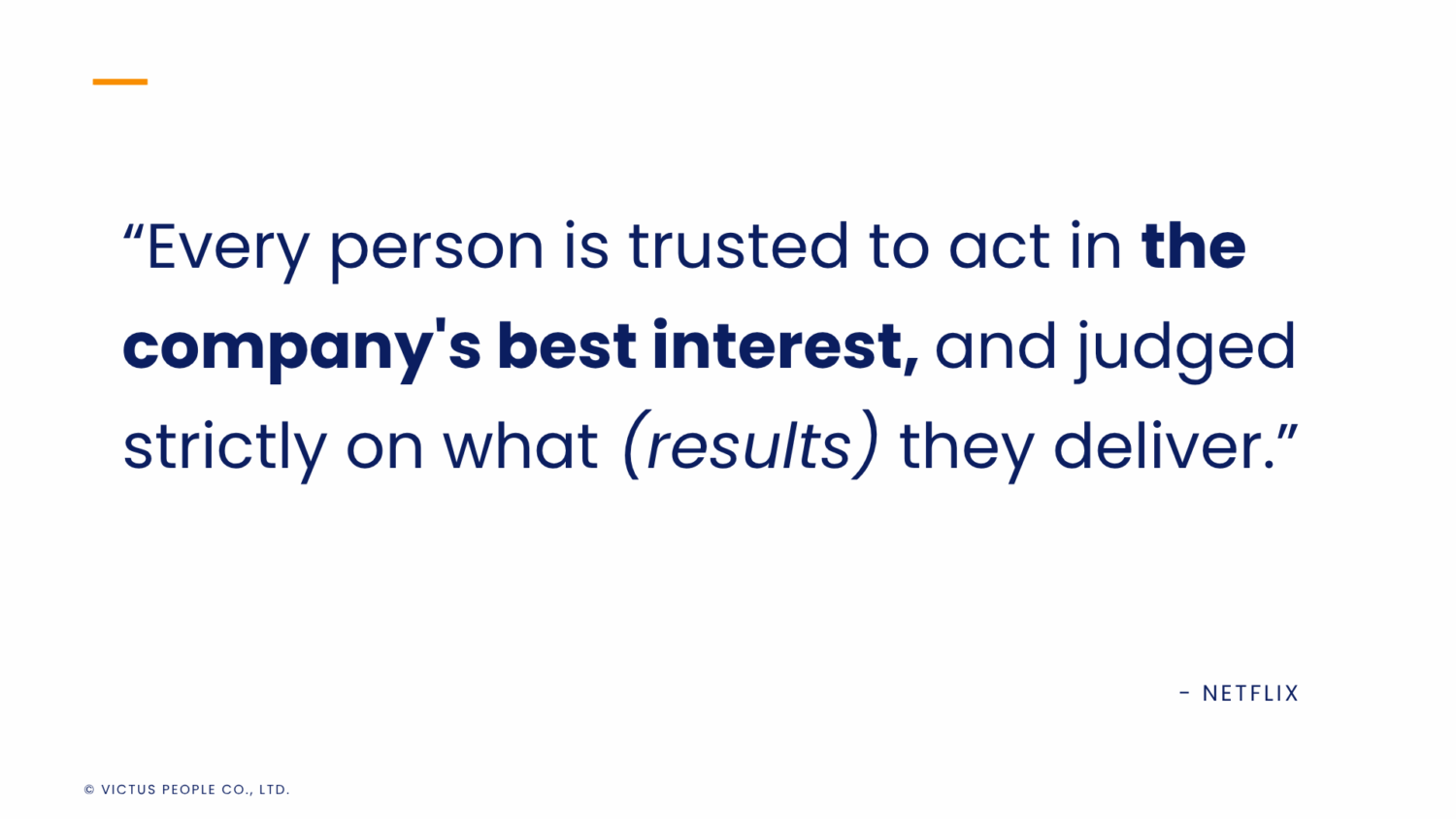
Same formula as before. Person times Environment. Netflix simply built the environment that demands and rewards outcome ownership. That’s exactly the gap the client was describing on our call.
You don’t need to go to such extremes, Vanessa Druskat has shared the blueprint of how to build a high-performing team culture in her book “The Emotionally Intelligent Team”
Blocker #3: When the system is right, but the skills and mindset isn’t there yet
Sometimes you get the system right, the leadership is solid, the culture supports accountability and there’s still a gap.
Because people’s past experiences, upbringing, and even the broader culture they grew up in shape how they see their own role at work.
Not everyone has been conditioned toward a growth mindset. Plenty of genuinely good people do exactly what’s asked of them, diligently, and nothing beyond that because that’s what was expected of them their entire career, until now.
I’ll give you a personal example. We’re currently working on a project with a new team of six. Not your typical high-performing group. Three of them have hardly worked in a corporate setting before, and two are financially secure enough that money isn’t really their motivator.
So how do you get every single one of them genuinely committed to the outcome, not just the task? We built something we now call:
The Accountability Loop Framework
Building ownership of outcomes on a project
| This Loop works best with a baseline of psychological safety and accountability. | ||
| What it does | Diagnostic question | |
| Clarity | Who owns what, by when and why it matters | Can every person state their deliverable and deadline without checking a document? |
| Communicate | Structured review, regular surfacing of progress and problems | Do people raise a problem the week it appears, or only when it’s already late? |
| Course-correct | Deviation treated as information | When something slips, does the conversation start with “what do we adjust” or “whose fault is it”? |
| Celebrate | Specific, timely recognition of the ownership behaviour that drove the result | Is recognition specific, timely, and tied to the project’s result OR generic, delayed, and about individual results? |
At the individual level,
Skill gap → provide training, shadowing, and peer learning to close this quickly and reliably.
Mindset gap → this is harder and slower, and typically requires coaching, supported by mentoring.
Persistent misalignment → in some cases, despite coaching and support, an individual’s values or working style genuinely don’t fit the team or organisation’s culture of accountability.
Recognise this early and help that person find a better-fit environment.
Where this leaves you
Accountability for outcomes isn’t something you get by finding better people, or by giving one more motivational talk. It’s the result of alignment between the system, the leadership, and the individual.
If your team is stuck in a “that’s not my problem” pattern right now, don’t start by asking what’s wrong with the people. Start by asking which of these three — system, leadership, or individual — is actually where the gap lives. Fix that one first.
Ready to close the accountability gap in your team?
Diagnosing the gap is one thing. Building the habits, trust, and structure that hold it closed is another. That’s exactly what our High Performing Teams Program is built for.
Designed for leaders and teams in Bangkok, Thailand, this 90-day guided journey turns self-awareness into practical team norms, communication habits, and ownership behaviours that make accountability for outcomes stick. Rather than creating a short-term performance boost, the program helps Bangkok-based teams build stronger trust, clearer accountability, and more effective ways of working together over time. Teams who’ve gone through it see measurable gains in performance and team trust.
If you recognise your team in this article and are looking to build a high-performing team in Bangkok, book a free consultation. We’ll help you pinpoint where your accountability gap lives and identify what to fix first.
FAQ
Responsibility is being assigned a task. Accountability is being answerable for the result of that task — whether or not you completed the underlying action to standard.
Three factors most commonly drive it: unclear leadership behaviour and modelling, a team culture that tolerates sub-standard performance, and individual gaps in either skill or mindset. Most low-accountability environments involve more than one of these at once.
Start with clarity (who owns what, by when, and why), build in structured, regular communication, treat missed deadlines as information to act on rather than blame to assign, and recognise outcome-driven ownership specifically and promptly — not just general effort.
No, but they’re closely linked. Psychological safety is what allows people to be honest about problems early. Without it, accountability systems tend to produce concealment rather than genuine ownership.
If it’s isolated to one or two people, it’s likely individual — a skill or mindset gap. If the same pattern shows up broadly across a team, office, or region, it’s almost always a systemic issue rooted in leadership behaviour or culture, not personal attitude.
