


Victus People helps expat leaders in Bangkok and across Thailand understand how cultural differences influence communication, leadership and team dynamics. Our research-backed cross-cultural training provides practical insights into Thai workplace culture, helping international leaders communicate more effectively and unlock the full potential of their Thai teams.
Built on real workplace insights rather than cultural stereotypes, the program helps expat leaders bridge cultural gaps, reduce misunderstandings and adapt their leadership approach to the Thai context, creating stronger relationships, greater trust and more effective multicultural teams.
You’re Not the Only Organisation Facing Cross-Cultural Challenges
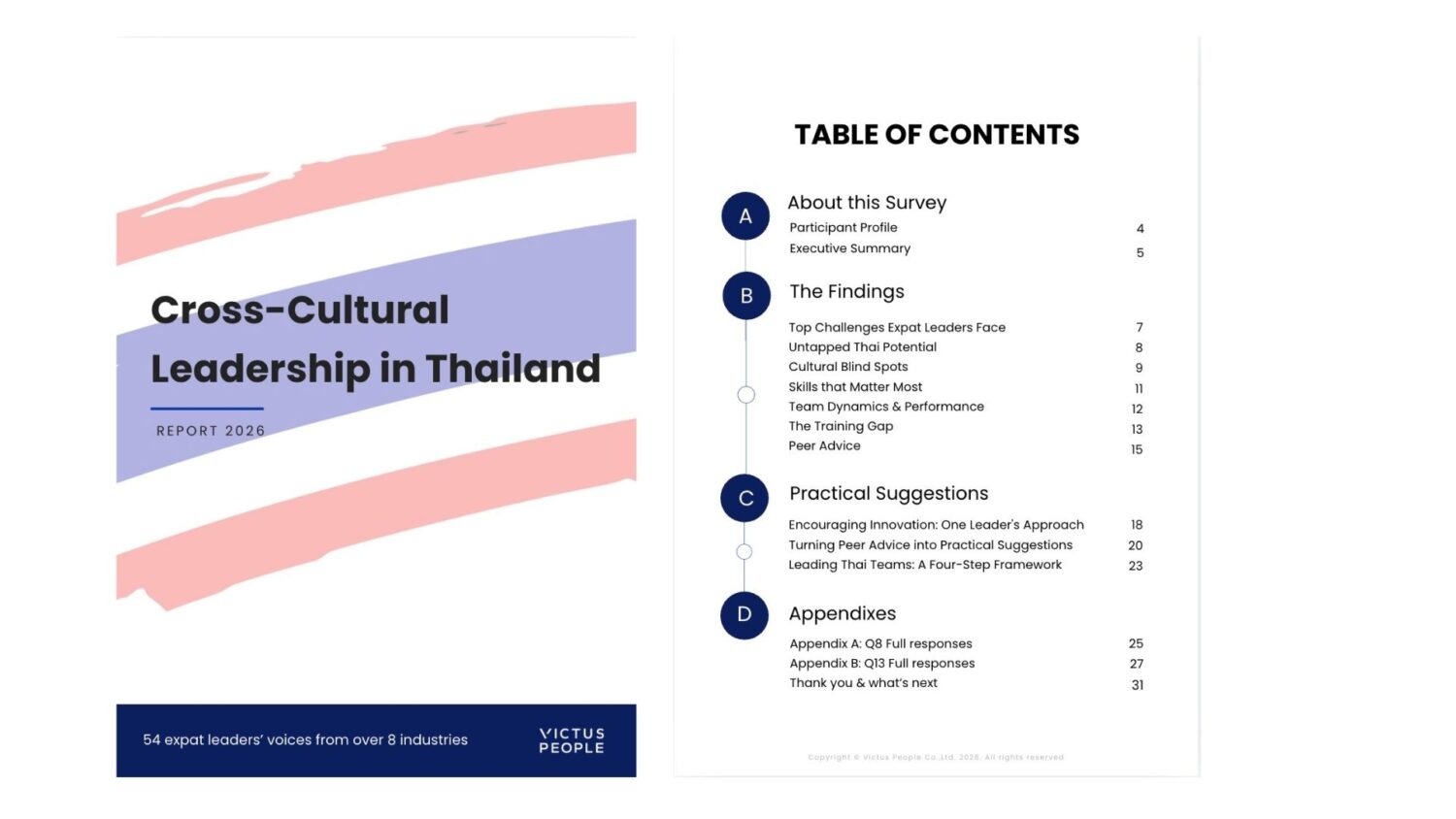
We surveyed 54 expat leaders managing Thai teams. Here’s what they told us.
Between September 2025 and January 2026, we asked expat leaders across Thailand what they struggle with, what they’ve tried, and what actually works.
The patterns were consistent across industries, team sizes, and years in Thailand.
65.8%
Average team potential expat leaders say they’re unlocking.
1/3 remains untapped.
74%
Received no formal cross-cultural training before managing Thai teams.
18.5%
Named “encouraging creative input and innovation” as their single biggest challenge, the most common answer.
“I sense they have more to offer but I’m not sure how to access it.”
Deputy General Manager, FMCG
Why Your Thai Team Won’t Speak Up
This isn’t a “you” problem. It’s a pattern. And there’s a reason it keeps happening.
Your Thai team isn’t holding back because they’re passive.They’re holding back because it’s not safe yet.
In Thai workplace culture:
- Speaking up in a meeting risks embarrassment for yourself, and for others.
- Giving honest feedback risks causing your boss to lose face.
- Saying “I don’t understand” risks losing face for yourself.
- Disagreeing risks breaking harmony.
Your Thai team isn’t avoiding these things because they don’t care. They’re avoiding them because Thai culture values trust, safety, and respect first.
What you’re seeing isn’t disengagement. It’s the absence of psychological safety the conditions Thai team members need before they’ll risk speaking up, sharing ideas, or pushing back.
Until those conditions exist, the ideas, feedback, and initiative stay locked inside.
The work isn’t making your Thai team more Western. It’s creating the conditions where Thai cultural strengths become assets, not obstacles.

Common Leadership Mistakes Expat Managers Make in Thailand
Most are well-intentioned. All of them backfire.
- Mistake #1: Asking them to “just be more direct. You’re asking them to abandon cultural norms they’ve lived by their whole lives without first building the trust that would make directness feel safe.
- Mistake #2: All task, no relationship.You skip the small talk, jump straight to business, focus only on deliverables. In Thai workplace culture, the relationship is the foundation for the work. Skip it and you’ve skipped the only thing that makes the work possible.
- Mistake #3: Reading silence as lack of capability.
Quiet meetings. No pushback. No questions. You conclude they’re disengaged or don’t have much to contribute.
What you’re actually seeing: “Yes may not always mean real agreement,” as one survey respondent put it. “You’ll hardly ever hear bad news directly from people concerned about it. You need someone in your org who acts as your ears.”
- Mistake #4: Saying “just be honest with me.” Words don’t create safety. Behaviour does. Telling someone to be honest puts pressure on them, it doesn’t remove the risk of speaking up. The risk is what’s stopping them.
- Mistake #5: Moving forward when you sense doubt.
You ask “Any concerns?” Get silence. Take it as agreement. Move forward.
Then a week later, the project is behind, the team is disengaged, and nobody can tell you exactly when things went wrong.
Who Is This Cross-Cultural Training For
This programme is designed for leaders managing teams of 5 or more. It works equally well as individual coaching, small-group cohorts (4-8 leaders), or in-house company programmes.
- Expat leaders managing Thai teams Tired of silent meetings, vague “yes” responses, and talented people who won’t fully engage. You sense the potential. You want a way to access it.
- New-to-Thailand managers You’ve just arrived, or you’re about to. You want to build the right foundation from day one not learn through eighteen months of painful mistakes.
- HR directors and L&D leads You’re preparing expat leaders for Thailand assignments, or supporting leaders already struggling with cross-cultural challenges. You need a programme grounded in evidence, not generalisations.
- Global mobility teams You’re relocating senior leaders into Thailand and want pre-arrival or first-90-days cultural preparation that goes beyond surface-level briefings.
Cross-Cultural Leadership Training for Expat Leaders in Thailand
A research-backed programme designed for expat leaders ready to access the full potential of their Thai teams.
This isn’t cultural awareness training. It’s not a list of dos and don’ts about wai-ing and not pointing your feet at people.
It’s leadership development for the specific challenge of leading across cultures in Thailand built on primary research with 54 expat leaders, grounded in the academic work on psychological safety (Amy Edmondson, Harvard) and cross-cultural leadership (Erin Meyer, INSEAD), and shaped by years of coaching expat leaders through exactly the patterns described above.
What you’ll work on:
1. Reading what's actually being said:
Thai workplace communication is high-context. Most of the message lives in what isn’t said. You’ll learn to recognise hesitation signals, decode indirect language, and tell the difference between agreement and politeness.
2. Building trust the way Thai teams build trust
Trust in Thai workplace relationships isn’t built through transparency declarations or town halls. It’s built through small, consistent actions over time. You’ll learn what those actions are, why they work, and how to integrate them into how you already lead.
3. Creating psychological safety in a high-context culture
The standard Western playbook for psychological safety “speak up, challenge each other, embrace conflict” doesn’t translate. You’ll learn the Thai-context version: how to design meeting structures, feedback mechanisms, and one-on-one conversations that make it safe for your team to contribute honestly.
4. Giving feedback without causing loss of face
Feedback that builds growth in Thai teams looks different from feedback that builds growth in Western teams. You’ll practice specific techniques for delivering critical feedback, surfacing problems early, and addressing performance issues, all without the cultural cost that usually comes with directness.
5. Adapting your leadership style without losing yourself
This isn’t about pretending to be Thai. It’s about expanding your range as a leader so you can lead effectively here without abandoning who you are or what made you successful elsewhere.
Format:
- The programme runs as a 1 day intensive workshop for groups of 6-12 leaders, or as individual executive coaching over 3 months for leaders who prefer one-to-one work.
In-house company programmes can be customised for your team’s industry, structure, and specific challenges.
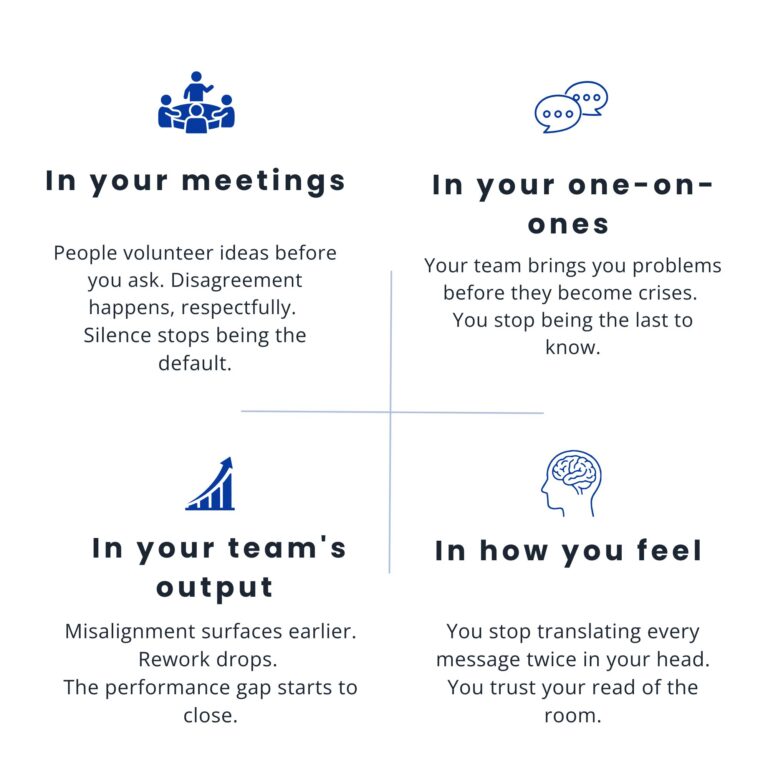
WORKSHOP OUTCOMES
Ready to access the full potential of your Thai team?
Every cross-cultural leadership engagement starts with a conversation. We’ll listen to what’s happening in your team, what you’ve already tried, and what outcomes matter most to you. From there, we’ll recommend the format that fits workshop, coaching, or in-house programme.
Why Choose Victus People for Cross-Cultural Training for Expat Leaders in Thailand
Victus People is a Bangkok-based training provider building cross-cultural training around real evidence, not generic dos-and-don’ts about local customs.
- Built on primary research. Grounded in a survey of 54 expat leaders across Thailand conducted between September 2025 and January 2026, so the program addresses patterns leaders actually report, not biased judgements.
- Backed by academic frameworks. Shaped by Amy Edmondson’s (Harvard) work on psychological safety and Erin Meyer’s (INSEAD) work on cross-cultural leadership, applied specifically to the Thai workplace context.
- Not cultural-awareness training. This isn’t a list of dos and don’ts about wai-ing or pointing your feet. It’s leadership development for the specific challenge of leading across cultures in Thailand.
- Flexible delivery. Runs as a 1-day intensive workshop for groups of 6-12, individual executive coaching over 3 months, or a customised in-house company program.
- Shaped by years of coaching expat leaders. Built from patterns seen repeatedly while coaching expat leaders through exactly these challenges.
- Based in Bangkok, working with leaders across Thailand. In-person or virtual delivery anywhere in Thailand with programs built for teams and leaders anywhere in the country.
FAQS
1. What is cross-cultural training for expat leaders in Thailand?
Cross-cultural training helps expat leaders understand how Thai workplace culture can influence communication, decision-making, feedback, hierarchy and team dynamics. The goal is to help leaders adapt their approach without relying on stereotypes.
2. Who is this cross-cultural training program designed for?
The program is designed for expat managers, international leaders and multinational teams working with Thai employees in Bangkok and across Thailand. It is especially useful for leaders who are new to Thailand or managing culturally diverse teams.
3. How can cross-cultural training help me lead a Thai team more effectively?
It helps you recognise where cultural differences may be affecting trust, communication and performance. You can then adjust how you give feedback, set expectations, handle disagreement and build stronger working relationships with your team.
4. Is the training based on real workplace insights in Thailand?
Yes. The program is research-backed and focuses on real workplace behaviours and challenges experienced by international leaders and Thai teams, rather than relying on broad cultural assumptions.
5. Is cross-cultural training available in Bangkok and elsewhere in Thailand?
Yes. Victus People can deliver cross-cultural training in Bangkok and support leaders and teams across Thailand, including virtual delivery for organisations based outside Bangkok.
RESOURCES

Coming soon

Cross-Cultural Leadership in Thailand 2026
