


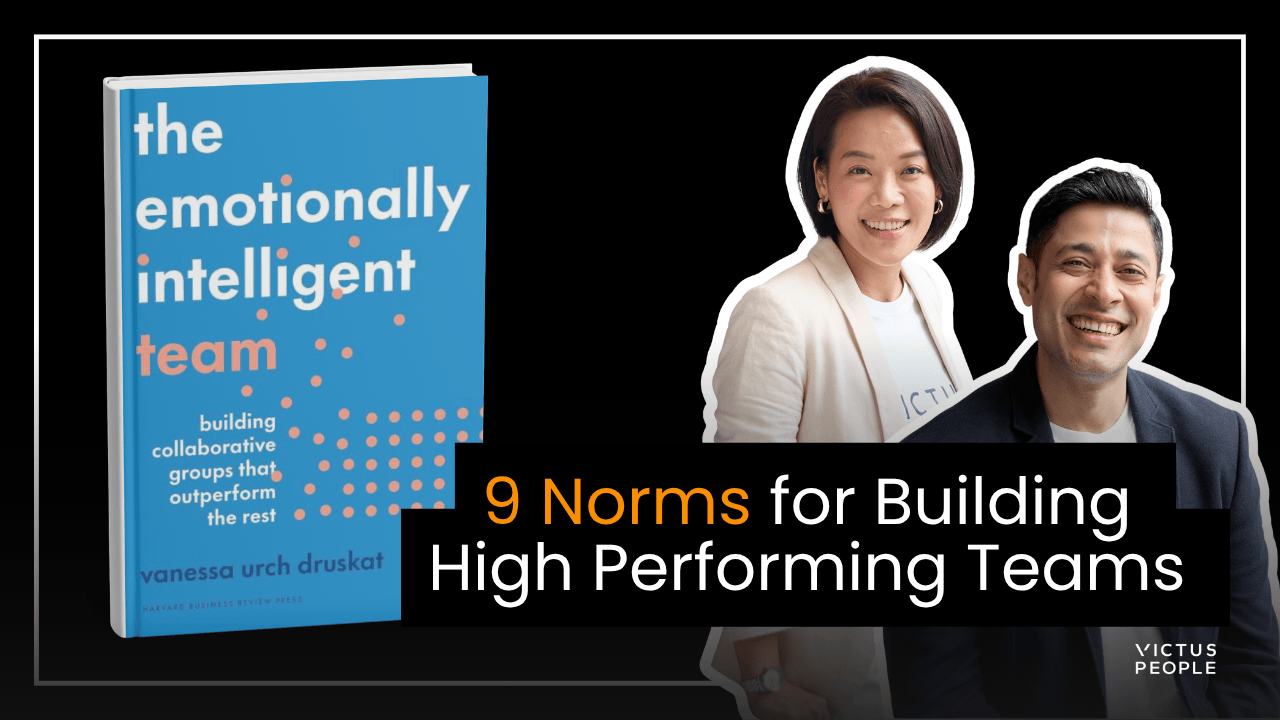
On our recent client call, the regional leader stopped us mid-pitch and asked, ‘what are these norms you’re referring to?’
We’d just told her that the most effective way to build a high-performing team is through building the right norms. These norms help teams have honest conversations, build internal alignment and promote a sense of ownership.
Nope, we didn’t come up with these norms. These norms are the outcome of Dr. Vanessa Druskat‘s three decades of work in studying what separates high-performing teams from other teams.
She found patterns of behaviour that, when practised consistently, create the emotional and psychological conditions for a team to do its best work together.
She divided them into 9 norms. This newsletter walks you through all nine, with a simple activity for each one you can try with your team right away.
By the end, we hope you’ll see your own team a little more clearly. And know exactly where to start.
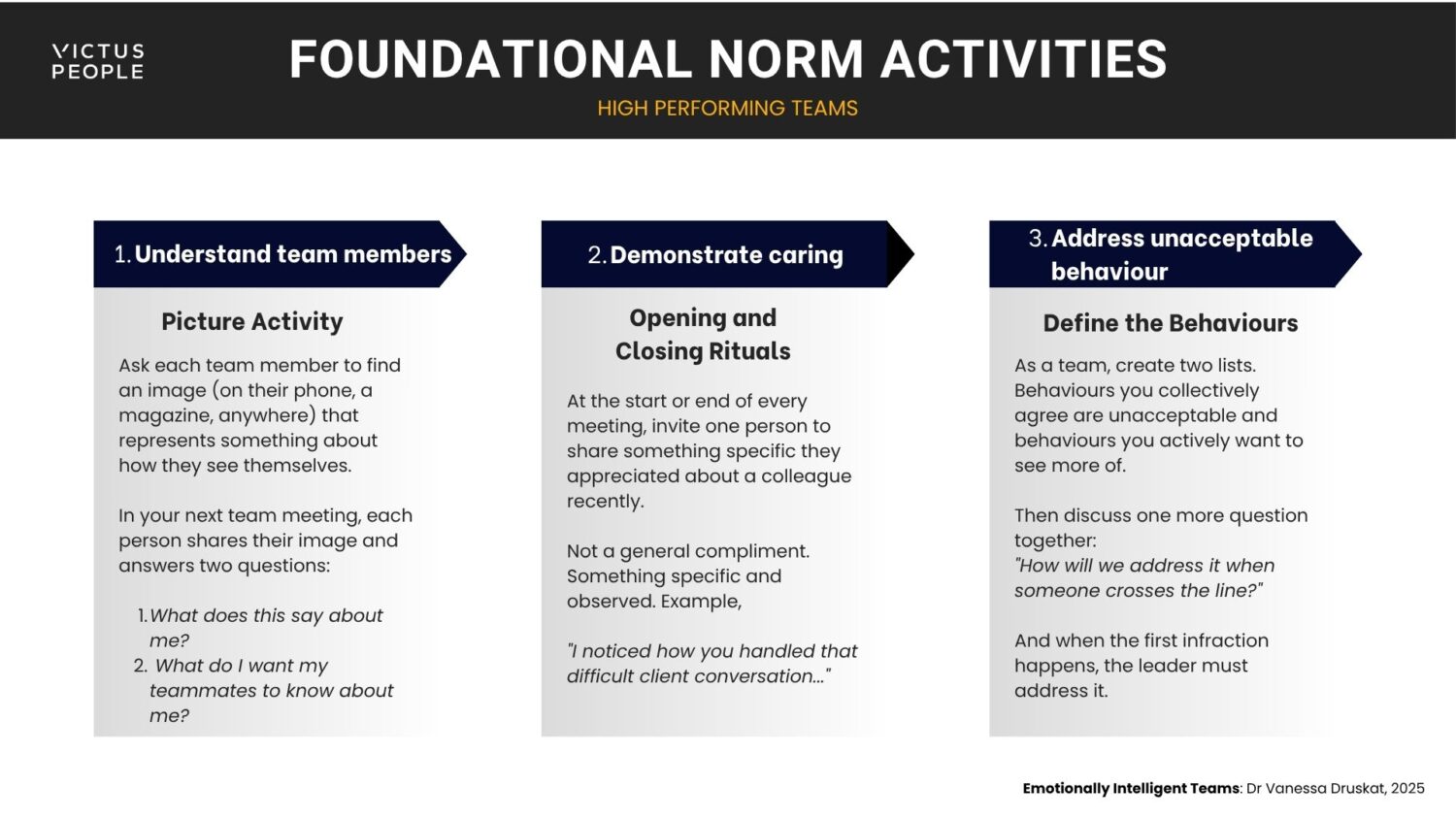
THE FOUNDATION – how we help one another succeed
Norm 1 – Understand team members (Learn the talents, motivations and preferences of each person)
A researcher asked her MBA students to visit each other’s homes.
When the group visited their Chinese classmate’s place, there was no furniture. He pulled out a photo of his wife and child back home. People he wouldn’t see for two years.
That one visit made a huge impact on the classmates. His silence in class, which everyone had read as disinterest, had a new meaning.
Understanding your colleagues’ world gives you a window into why they behave so ‘frustratingly’ different from you.😬
Norm 2 – Demonstrate Caring (Tell your colleagues the value they bring to the team)
An engineer was struggling to explain the root cause of a problem to her team. A colleague stood up, walked to the board and drew a diagram. The team immediately understood. The meeting moved forward.
But no one said a word to the person who had helped.
Later, when Vanessa acknowledged her, she replied:
“Are you sure? I thought it took up time we could have used in our discussion.”
In team settings, our brains constantly scan for two signals:
- Am I valued here as a person?
- Does my contribution actually matter?
Every time you appreciate a colleague specifically and out loud, you answer both questions.
Norm 3 – Address Unacceptable Behaviour (Make feedback a gift)
Kim Scott, author of Radical Candor, once had a team member who was well-liked but underperforming. She avoided the conversation. She kept the peace and hoped things would improve. Eventually she had to let him go.
When she did, he was devastated. What hurt him the most was that he thought they all cared about him.
When unacceptable behaviour goes unaddressed, two things happen:
- The person never gets the chance to grow.
- The rest of the team quietly loses trust.
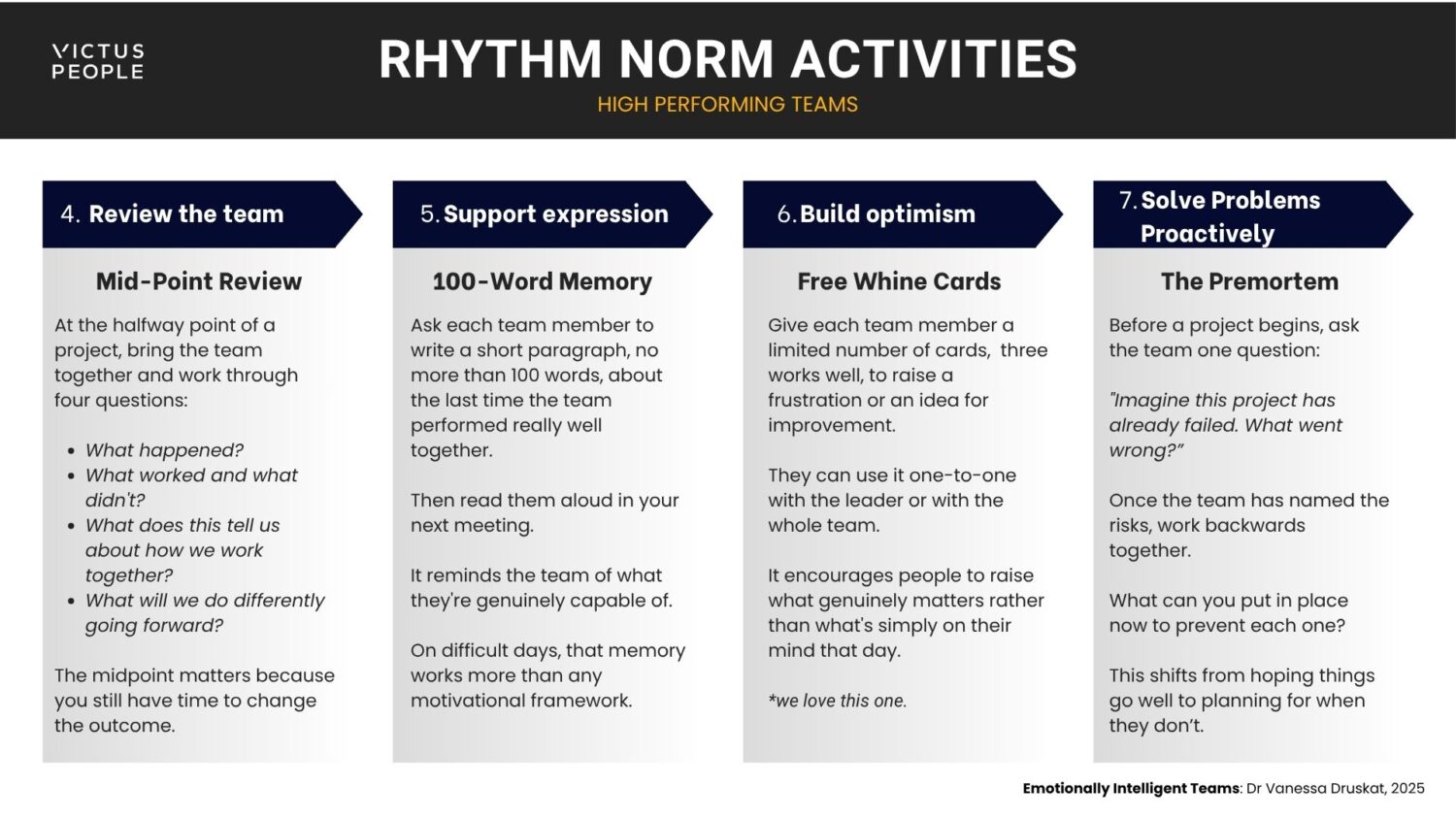
THE RHYTHM – how we learn and advance together
Norm 4 – Review the team (Routinely evaluate where team is thriving and where team is struggling)
Regular reflection is how high-performing teams stay sharp. Most teams don’t do it.
Military units have made debriefing a standard discipline for over 50 years. NASA astronauts spend an entire month reflecting after each mission. Surgical and emergency room teams review after every critical procedure.
They all arrived at the same conclusion. You do not improve by doing more. You improve by stopping to understand what you have already done.
Norm 5 – Support expression (Create rituals to have honest conversations)
Steve Jobs described the best creative teams as rocks in a tumbler. Thrown together, knocking against each other, uncomfortable. It’s the friction that polishes them.
Creating the conditions where people feel safe enough to say what they actually think is extremely crucial for the team’s success.
Because a team where everyone agrees all the time isn’t a high-performing team. It’s a team where people have stopped being honest.
Norms 6 – Build optimism (Practice for building team resilience)
Before a big presentation, a team member opened her laptop to find a post-it note on the screen. It read:
“Remember, we rock.”
The team member later said it changed how she walked into that room.
Our brains are naturally wired for pessimism. That instinct kept our ancestors alive. But in a team setting, it tends to work against us.
When negative thoughts take hold, we become less attentive, less creative and more likely to withdraw from the people around us.
The good news is that optimism isn’t a personality trait that only some people have. It can be built. And it can be practised.
Norm 7 – Solve problems proactively (How you stay ahead of the problems)
In 2003, engineers on the NASA Columbia mission raised concerns that a tile had broken off the shuttle during launch. They believed it could potentially be repaired in flight.
Management assessed the risk as low and decided not to act. When the shuttle re-entered Earth’s atmosphere, it broke apart.
In many organisations, asking for help before something goes wrong is associated with not being competent enough to handle it yourself. So people wait. They sit with uncertainty, push forward without the input they need, and hope things work out.
Pixar Animation Studios built something called the Brain Trust, where directors invite leaders from across functions to review a project in progress. The more diverse the group, the richer the thinking.
The goal is to surface problems and blind spots while there is still time to address them.
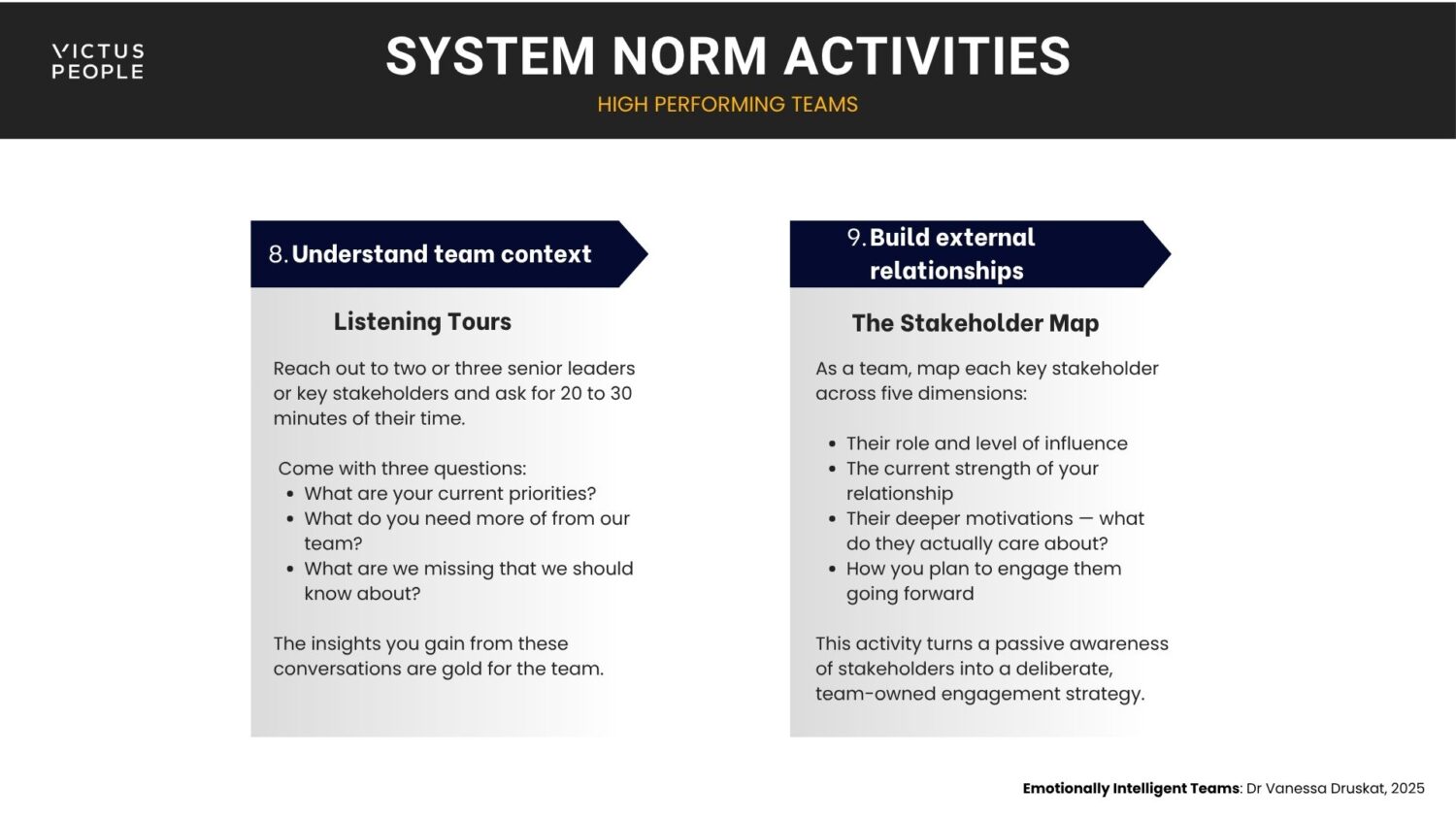
THE SYSTEM – how we engage our stakeholders
Norm 8 – Understand Team Context (How you grow organisational awareness)
Every team exists inside a larger system. Understanding that system helps teams understand the world around them.
Two questions sit at the heart of this norm.
- Why does this team exist?
- And how does what it does actually contribute to something larger?
When team members can answer those questions clearly and personally, it connects their everyday work to a larger sense of meaning.
Norm 9. Build External Relationships (how you stay connected and learn from the people who matter)
A study of 100 top-performing leaders found that they spent almost 60 percent of their time reaching out to people outside their immediate team.
High-performing teams are not islands. They actively maintain relationships with stakeholders across the organisation and beyond. These relationships give the team access to information, support and perspective it cannot generate from within.
These nine norms are not a checklist.
They are a culture. And like any culture, they are built slowly, through small and consistent actions repeated over time.
If you would like to understand how your team measures up, download our Team Performance Assessment survey resource available on our website (free download).
https://victuspeople.com/free-resources/
This newsletter is dedicated to the research of Dr. Vanessa Druskat, author of The Emotionally Intelligent Team. A carousel series diving deeper into each norm is coming soon.
