



Here’s a question we ask every leader: If you put eleven Cristiano Ronaldos on a football pitch, do you win? The instinctive answer is yes, until you think it through. Everyone wants the ball. No one defends. Teamwork collapses into a battle of egos.
This is the talent paradox. Great individual performers don’t automatically make great team players. And yet, leaders often believe building high-performing teams requires hiring an A player, setting ambitious targets, and providing clear direction, et voilà. They’re missing an important component.
In our experience providing high-performing teams training across Asia, performance is the result of intentional design. Creating the conditions that allow trust, clarity, and collaboration to genuinely take root. This is especially true in workplaces where hierarchy and harmony can quietly mask the very tensions that hold teams back.
This article walks you through exactly how to do that: what makes a high-performing team, what leadership qualities are needed to build one, and the practical steps to get you there.
What Makes a High-Performing Team?
Most people define high-performing teams by results. Targets were hit, deadlines were met, and revenue was achieved. And yes, some teams do hit their numbers. But if your retention rate is high, ideas only flow from the top down, and not everyone speaks up in meetings, you don’t have a high-performing team. You have a high-pressure one. And that’s not sustainable. Results matter. How you get there matters just as much.
After studying organisational teams for over two decades, Vanessa Druskat and her team of researchers found that “members in high-performing groups could articulate one another’s likes, dislikes, concerns, motivations, biases, and peeves.” In other words, they knew each other as people, not just roles. In such teams, decisions are made faster, information flows effortlessly, and valuable products get launched sooner and more cheaply. Here, the best ideas constantly compete with each other to rise to the top.
In our work with teams, we’ve found that truly high-performing teams share a set of observable qualities:
-
Ideas, concerns, and mistakes are shared without fear
-
Roles, expectations, and priorities are clear and followed
-
Information flows freely, and conversations stay constructive
-
Members deliver reliably and support one another under pressure
-
The team adapts, learns, and moves forward together
These qualities don’t emerge on their own, which is precisely why creating high-performance teams is a leadership responsibility, not simply a team-building exercise.
How Do You Know Your Team is High-Performing?
You can’t build what you can’t see. And you can’t fix what you haven’t measured. Before investing in team development, leaders need the right framework to assess what’s working and where the gaps are.
We use the Insights Discovery® Team Effectiveness Model, which measures team health across four interconnected pillars: Focus, Process, Flow, and Climate. The spanning 32 validated attributes give you an honest, objective picture of where your high-performance work team is today and where it needs to grow.
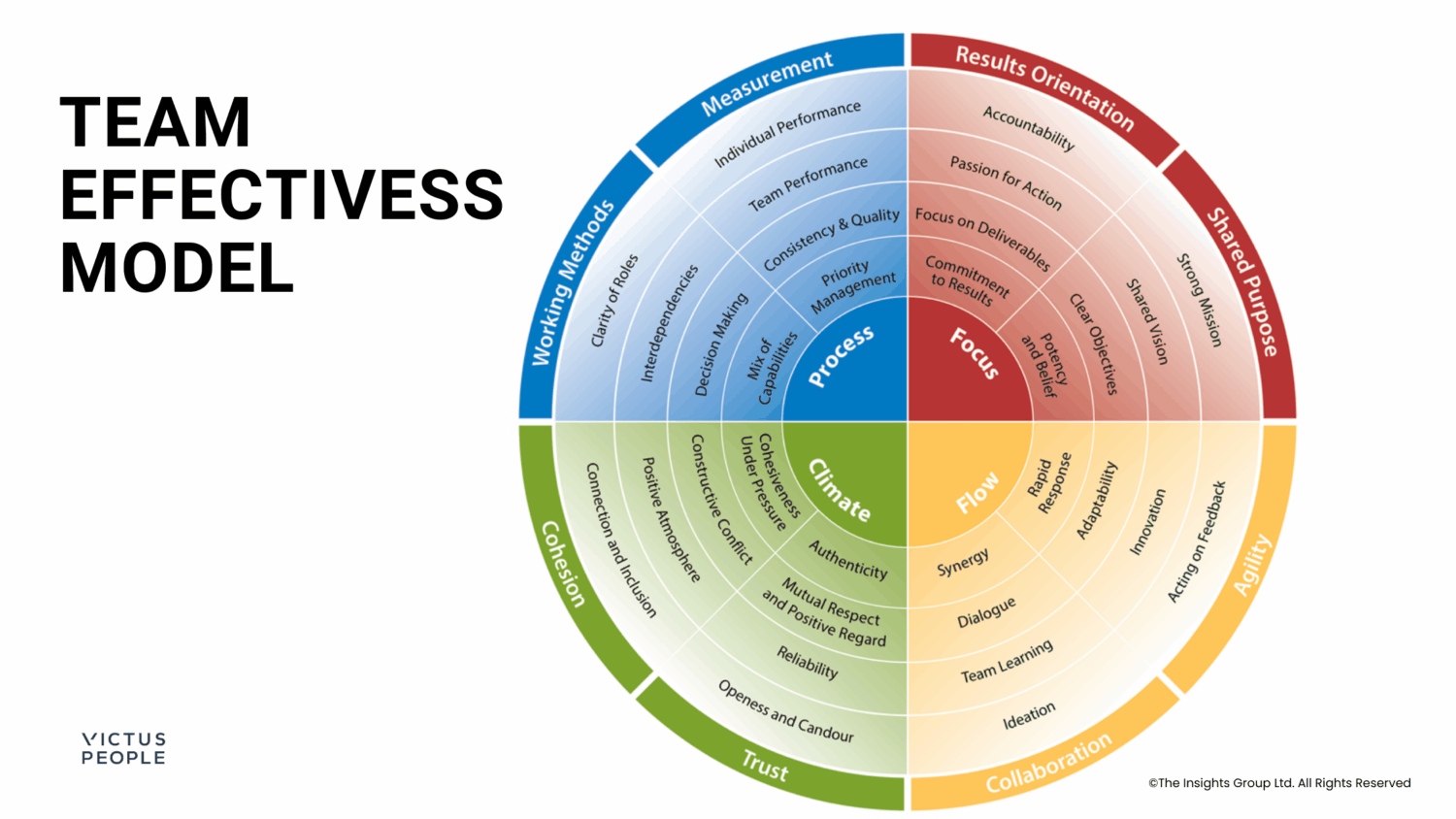
The Pillars of High-Performance Team Leadership
Research by Cornell University and Green Peak Partners found that self-awareness is the strongest predictor of leadership success. Who you are as a leader matters far more than what you know.
From Command-and-Control to Coach-and-Empower
Recently, we spoke with Zozo Abrahams, a global consultant with over 26 years of training experience across continents, and this is the leadership philosophy she learned from her best manager of all time:
“Become so skilled… that you won’t need me at all.”
Most leaders say they want to develop their people. Few are willing to make themselves unnecessary. That’s the difference between a manager and a leader who builds a genuinely high-performing team.
The 4 Manifestations of Leadership
Through Insights Discovery®, we’ve found that high-performance team leadership develops versatility across four distinct leadership manifestations. Knowing which one a situation calls for and flexing accordingly is one of the highest-potential leadership capabilities.
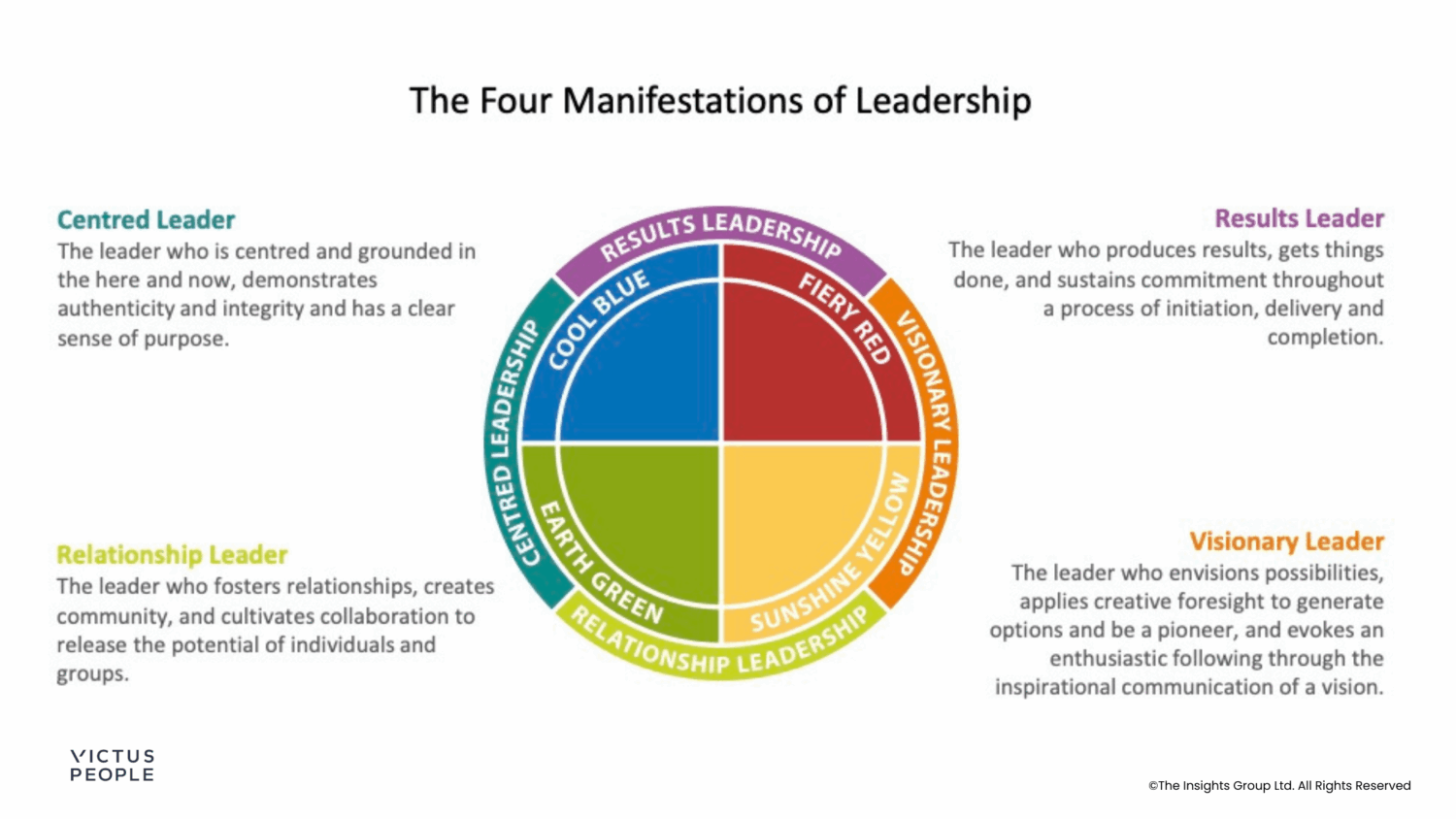
Navigating Conflict and Creating Psychological Safety
In hierarchical cultures, people often don’t push back; they go quiet. They agree in the room and disengage outside it. High-performing team leadership in Asia means learning to read what’s not being said.
One phrase that Zozo encourages leaders to use:
“This is what I’m noticing….I might be wrong, but I’d love to hear your thoughts.”
Then stay quiet. That single habit builds more psychological safety, and that is where honest conversations begin.
How to Build a High-Performing Team: A Step-by-Step
Most team-building efforts fail for one simple reason: they’re events, not processes. A workshop here, a team lunch there, and then everyone goes back to the same dynamics as before. Real team growth requires reflection, honesty, and deliberate action done consistently over time.
Inspired by David Kolb’s experiential learning cycle and Vanessa Druskat’s decades of research on high-performing teams, here is a practical 4-stage process your team can start using today.
Stage 1: Look Back Honestly
Choose a specific time or project experience to review. Before any discussion happens, give your team a way to anonymously rate their collective performance so you’re working with honest data, not polished perceptions.
Tip: The best time to do this is at the midpoint of a project. You have the past to learn from and enough time left to change the future.
📥 Download our free Team Performance Assessment to get started.
Stage 2: Reflect Individually, Then Discuss Together
Before the team meets, ask each member to privately reflect on four prompts:
-
What was a high point?
-
What was a low point?
-
What surprised us negatively?
-
What surprised us positively?
Individual reflection first is critical. It ensures every voice enters the room with a perspective, not just the loudest ones. In the team discussion that follows, the goal is simple: see the full picture together. What can you learn from your successes? What would you do differently?
In Asian teams, especially, creating structured space for individual reflection before group discussion dramatically increases the honesty and quality of the conversation.
Tips: Not sure where to start? We’ve put together a free set of Team Feedback & Reflection Questions designed to deepen team awareness and surface the conversations that matter most, available alongside our other free tools for building high-performing teams.
Stage 3: Bring in Outside Perspective
Once gaps and opportunities are identified, invite an expert, coach, or facilitator to help the group go deeper. It also allows the leader to fully participate in the discussion.
Gathering feedback from key stakeholders, clients, vendors, or senior leadership gives the team an outside-in perspective on how their work is actually experienced.
Stage 4: Commit to a Concrete Action Plan
Reflection without action is just a good conversation. By the end of the process, your team should walk away with a clear action plan that answers:
-
What needs to change?
-
Who owns it?
-
When will it happen?
-
How will we know it’s working?
Set a follow-up review date before you leave the room. That single step can be the difference between a team that talks about change and one that actually makes it.
📥 Download our free How We Grow tool to help your team build and track new norms.
Then start again. The most high-performing teams we work with don’t do this once. They make it a rhythm: quarterly, at project milestones, or whenever the team feels stuck. Over time, this process becomes the team’s own, and that’s exactly where you want to be.
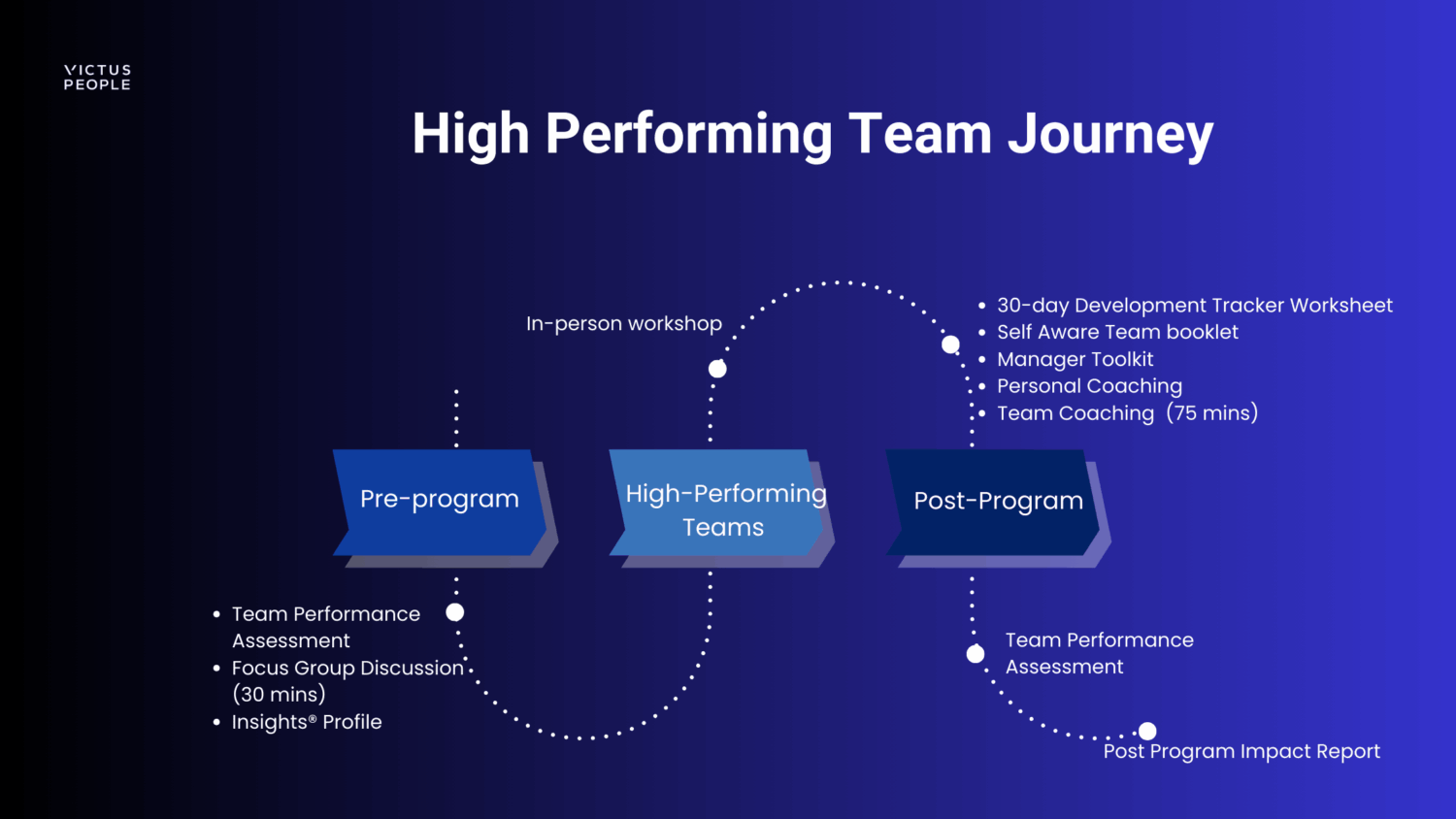
Overcoming the Common Barriers to High-Performing Teams
In our experience working across Asia, the same barriers come up time and again. Here are 3 of them.
Barrier 1: Silos in Hybrid Environments
When teams are split across locations, floors, or time zones, collaboration usually breaks down quietly. Information gets hoarded, decisions get made in small groups, and before long, the team becomes a collection of sub-teams, each pulling in slightly different directions.
What helps is creating deliberate touchpoints where people reconnect, not just on tasks, but on how they’re working together. Shared norms and a common language make the difference between a team that co-exists and one that genuinely collaborates.
Barrier 2: The Trust Gap
This one is especially common in Asia, where teams are led by expat leaders. An expat leader arrives with excellent intentions. But without understanding how local cultural values shape the way people approach work. For example, in Thailand, a leader must understand how the deep respect for hierarchy, the importance of face-saving, and the preference for harmony over confrontation influence the way members interact with the leader.
Leaders who don’t understand that end up misreading everything. Silence gets interpreted as disengagement. Deference gets mistaken for a lack of initiative. Careful word choices look like evasiveness.
Meanwhile, the team is experiencing something equally frustrating. A leader who doesn’t take time to understand their context feels distant, transactional, and unsafe to be honest with. So they do what feels natural. They agree in the room and disengage outside it. Neither side is wrong. Both sides are stuck.
Bridging this gap starts with genuine curiosity. A willingness from the leader to understand not just what their team does, but how and why they do it. And it requires creating structured moments where honest conversation becomes safe enough to happen.
Barrier 3: The Absence of Emotionally Intelligent Team Norms
When teams lack self-awareness and a shared framework for working together, small frictions quietly accumulate. Misunderstandings become patterns. Patterns become silos. And silos become the invisible ceiling on what the team can achieve.
The missing ingredient is emotionally intelligent team norms. Explicit, agreed-upon ways of working that account for differences across personalities, cultures, and working styles. Teams that invest in building these norms turn diversity into their greatest competitive advantage.
The Power of High-Performing Teams Training
Most organisations invest in training and see little lasting change because a single workshop cannot rewire how a team thinks, communicates, and works together.
Research consistently shows that sustainable behavioural change requires repeated practice, honest reflection, and accountability over time. That’s what high-performing team training should deliver.
Effective high-performing team training focuses on three things most programs skip:
-
Building self-awareness at the individual level,
-
Creating emotionally intelligent team norms, and
-
Measuring behavioural change with real data.
When those three elements work together, teams build the capability to keep improving themselves.
In one of our recently completed programs, a recruitment team recorded a 100% improvement in communication openness and an 80% increase in confidence in closing deals, measured before and after the program with our Team Performance Assessment.
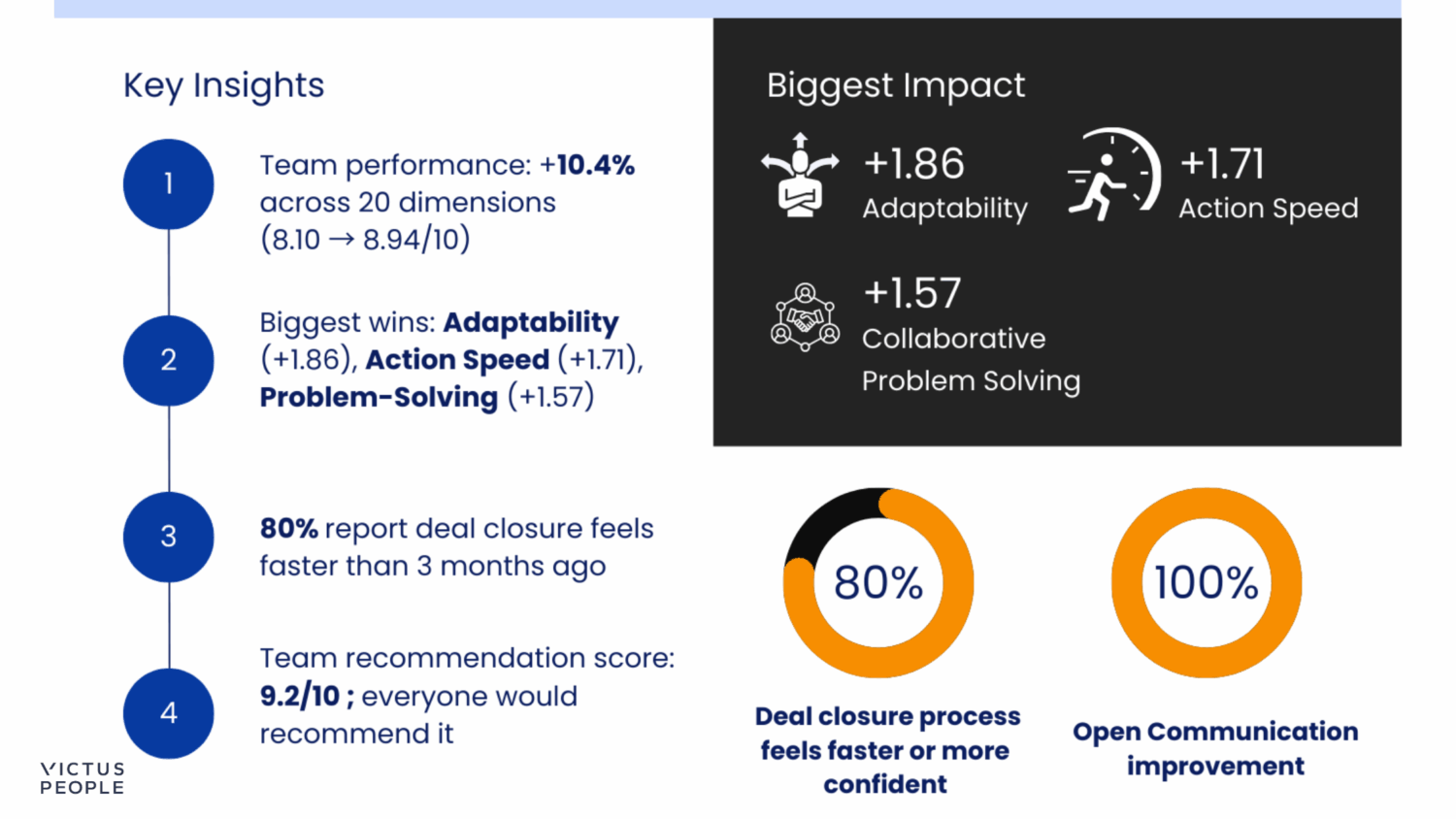
Conclusion
Building a high-performing team requires three things: self-aware individuals, emotionally intelligent team norms, and leaders who create the conditions for trust and honest conversation to thrive. It’s a continuous journey, not a one-time fix.
Whether you’re just beginning to think about how to build a high-performing team or looking for structured high-performance team training to take an already capable group to the next level, the foundation remains the same. Your team already has what it takes; the question is whether they have the conditions to show it.
At Victus People, building high-performing teams across Asia is what we do, as Thailand’s first Insights® Discovery partner, we combine a proven psychometric framework with hands-on facilitation designed specifically for the cultural complexities that teams here navigate every day. Our High Performing Teams training program is built around the same principles. Whether you’re leading a cross-cultural team in Bangkok, managing a hybrid team across time zones, or simply looking to develop a high-performing team that sustains its growth, we’d love to explore what that journey could look like for you. Your team already has what it takes. The question is whether they have the conditions to show it. If you’re ready to find out, contact us today!
