


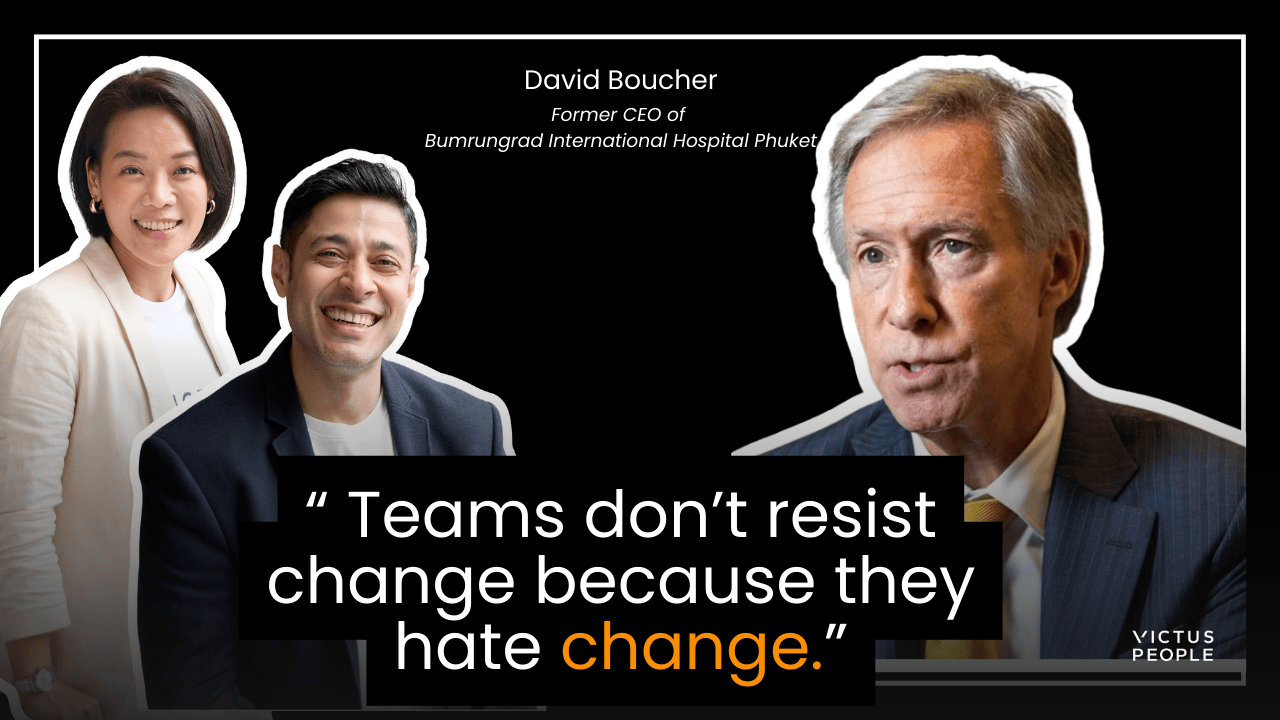
What does it take to lead organisational change in multicultural healthcare teams?
When a hospital is five months from bankruptcy and the community calls it ‘no hope,’ what does a leader do first? Fire people? Cut costs? Bring in consultants?
David Boucher, MPH, FACHE did something different. He listened.
For David Boucher — ex-CEO of Bumrungrad International Hospital Phuket with 47 years leading hospital turnarounds, who jokes he doesn’t have an MBA but an “MBWA” (Management By Wandering Around), and has lectured at Harvard, Yale, and Cornell MBA programs — leading change involves:
- Listening with all your senses – visiting diagnostic centers, physiotherapy units, and frontlines before you dare suggest solutions
- The courage to act fast – firing a Chief Nursing Officer within 12 hours when the hospital has 5 months before bankruptcy
- Opening yourself to brutal truth – implementing customer surveys even when you know the feedback will hurt
- Depositing into the trust account early – building “street cred”, spending nights with staff, and remembering their birthdays
- Respecting the local culture – adapting global best practices to fit the communities you serve
- Leading with your humanity intact – he still cries talking about the day his nurses wore their white graduation hats with pins, a symbol that hope had returned
In this 75-minute conversation, David shares the hard-won wisdom from 47 years of leading change across hospitals, service and cultures; from the U.S. to Thailand, from “no hope” to top-performing.
What’s the first thing leaders should do when leading organisational change?
David’s answer: Listen.
Not from the boardroom. Not through reports. But by wandering the halls.
“At most organisations, front-line employees already know where the problems are and what needs to be done,” David explains. “They’re waiting for someone to actually ask them.
When David arrives at a new hospital, he dedicates his first days to the frontlines. Observing body language of the staff, talking to nurses during shift changes, visiting diagnostic and physiotherapy centres.
He uses all his senses: noticing the movement of staff, smelling outdated infrastructure, hearing the frustration in physicians’ voices when systems fail them.
This isn’t just data collection. It’s trust building.
When staff see you genuinely listening (and not just doing a PR tour) they start sharing real, implementable solutions, he explains. The answers are already in your organisation. You just have to be humble enough to find them.
What are the biggest challenges to leading change in hospitals/multinational organisations?
In 1994, David walked into a hospital that was 5 months from bankruptcy. The community had given up on it. They literally called it the ‘no hope’ hospital. Here’s the cruel irony. While the hospital was dying, the staff had been told they were doing fine. Little sense of urgency. No accountability. Many half truths.
Three critical challenges that leaders face in crisis situations:
- Limited time – When you have 5 months before bankruptcy, you have to make some hard decisions – and quickly!
- Lack of employee desperation– Staff didn’t believe the crisis was real because leadership had sugarcoated a number of things
- Weak leadership – People in key positions who couldn’t (or wouldn’t) make the necessary changes
Within 12 hours of listening to the staff, David knew he had to let go of the Chief Nursing Officer. “In a crisis, you don’t have the luxury of coaching people up,” David says. Harsh choices need to be made fast.
He brought in a retired Navy hospital Chief Nursing Officer who knew how to run a tight ship. A year earlier, the top leadership team voluntarily took a 20% pay cut. The message was clear: everyone was accountable, starting from the top.
Within 12 months, they had built a high-performing leadership team. But the real transformation came at the 18-month mark.
For National Nurse’s Week, the Chief Nursing Officer had asked the nurse managers and staff: “If they would wear their white caps and pins from graduation?”
The following Tuesday, they came. Row after row of nurses in crisp white uniforms, white caps, and shining pins; like a formation of white doves…..angels even.
Even years later, David can’t tell this story without getting a bit emotional. “The local newspaper was inundated with letters from community members,” he recalls. “People couldn’t believe this was the same hospital.”
The hospital had earned back more than its reputation. It had earned back its soul. The hospital reclaimed its original name, Good Hope Hospital.
How can senior leaders lead change without losing trust?
David has a term for it: building “street cred” The respect or trust you earn because you’ve proven yourself. He shares, “If you want to be held in high esteem, you do esteemable things.”
What ‘street cred’ looks like in practice.
Unlike other CEOs, David spends 2-3 nights every year listening to his staff and understanding what it’s really like on the ground. He even accepts FB friend requests from his staff. He remembers and congratulates them on their important days like birthdays, anniversaries or big milestone moments.
Once he had implemented an employee engagement program, where he and the director ended up hand-washing his front line staff’s big truck, because she won the employee engagement challenge.

He deposits into the trust account before he ever needs to make a withdrawal.
Some call this approach unconventional. Others say it’s unsustainable for a CEO to be this accessible.
David doesn’t care. Because when change gets hard; when you need to fire a colleague, when you need staff to work twice as hard during a turnaround, when you need all employees to believe in a “no hope” hospital again, that trust account is what saves you.
The Harpal Story
Last month, David posted a photo on LinkedIn that got 34,000 impressions. It wasn’t about a hospital merger or a new strategic initiative.
It was a picture with Harpal Singh, the executive doorman at the Taj Hotel in Dubai.
Years earlier (2021-22), when David was Chief of Service Excellence at Aster DM Healthcare, he stayed at that hotel frequently.
In September, when David returned to the hotel near midnight on Saturday, Harpal still remembered his name. “That’s Unreasonable Hospitality,” David says, referencing Will Guidara‘s book.
Harpal’s service was extraordinary. The kind of “above and beyond” you want from your staff.
When you’re leading change across cultures, trust isn’t built in boardrooms. It’s built in parking lots, night shifts, conversations over donuts, and remembering names.
That’s how you earn the right to lead change without losing your people.
How do you get buy-in from your team when leading change?
Sometimes the best way to create urgency is to let the truth speak for itself.
In 2012, David walked into another crisis. The clinic chain’s CFO had just been sent to federal prison for embezzling $7 million. The hospital with 55 clinics spread across the region was reeling.
Most CEOs would start with town halls and reassuring speeches.
David implemented Patient Satisfaction Surveys across all 55 clinics. He knew the feedback would be brutal. That was the point.
“Employees needed a reality check,” David explains. “They needed to see from patients themselves just how far we’d fallen. No amount of me telling them would have the same impact as hearing it directly from the people we’re supposed to serve.“
Every completed survey went to the respective clinic manager and director. Any score below 5 out of 10 triggered a personal follow-up call from the respective regional director, many from David himself.
Patients were surprised. One of them couldn’t believe the CEO had called. Word spread fast. The survey response rate shot up to 4 times the industry standard. The message was clear to everyone: staff, physicians, patients, the community. This clinic brand was serious about change.
The Results Spoke Louder Than Any Speech
By 2017, the hospital had doubled its revenue from $80 million to $160 million. Their Net Promoter Score climbed to 80% from the mid-50s.
And the remarkable part is they achieved all of this without raising prices. “Not one single dime”.
Understanding What Drives Your People
David operates by a simple principle:
“Who we are is what we were, when.”
Our past shapes our present. Our backgrounds influence our perceptions, motivations, and what stresses us out.
A Vietnamese nurse raised during the Vietnam war and an American Chief Nursing Officer retired from the navy would see authority from a very different lens. This is why cultural intelligence matters so much in multicultural teams.
Leaders who understand their employees’ demographic and psychographic profiles are able to communicate and sustain change more effectively.
Research by Vanessa Druskat, author of the Emotional Intelligent Team, shows that high-performing teams develop what she calls “norms of interpersonal understanding”, the ability to recognise and work with each other’s differences rather than against them.
This is exactly what our Insights Discovery High-Performing Teams program is built on.

By helping leaders understand the psychological and behavioral profiles of their team members, we create the foundation of trust and psychological safety that makes genuine buy-in possible with authentic commitment.
You can’t mandate buy-in. You can only create the conditions where people choose to believe in the change you’re leading.
David created those conditions with brutal honesty, relentless follow-through, and deep understanding of what makes people tick. That’s how you turn a hospital on the brink of collapse into one that doubles its revenue without raising prices.
What disruptive change is coming to healthcare leadership?
David doesn’t hesitate, “Humanoid robots will be a game changer in the next 12 to 24 months.“
The Technology Revolution Is Already Here!
AI is already transforming patient care. Bumrungrad International Hospital in Bangkok became the first hospital in the world to introduce IBM‘s Watson for Oncology; a program that allows doctors to access the latest cancer treatment research with a single click, without having to read through thousands of medical journals.
Patient registration is increasingly handled by AI.
Elon Musk recently announced that Tesla‘s Optimus humanoid robot will perform surgeries “with 100% quality and perfection.”
Chinese robots are taking over service roles like escorting guests to their rooms.
David is old-school enough to joke,
“I don’t want an Avatar giving me my last shot of morphine when I’m in hospice.”
But he’s practical enough to see the bigger picture. Thailand is facing a shortage of 30,000 nurses. The United States needs more than 70,000. It’s a similar crisis around the world.
“Technology can take the administrative burden off their hands. Let nurses be human where it matters most.”
This isn’t about replacing people. It’s about amplifying humanity through technology.
His advice for the next generation of healthcare executives in Thailand?
Hi-Tech with Thai Touch
It’s the perfect encapsulation of David’s leadership philosophy and the future of healthcare itself.
Deploy AI, robotics, and data analytics to improve outcomes and efficiency. But never lose sight of what makes healthcare care: the human connection, the empathy, the street cred that comes from genuinely making people feel valued.
Technology will change how we deliver healthcare. But the principles of leading change – listening, building trust, understanding your people, creating buy-in through truth – those remain timeless.
Leadership is about people.

